Forecast bias plays a pivotal role in shaping actual investment decisions rather than being a mere theoretical concept. The recent study linking behavioral tendencies to concrete trading records reveals that differing biases among investors lead to distinct stock purchasing and selling strategies.
Understanding Forecast Bias in Trading
This research illustrates that forecast bias isn't confined to theoretical values; it manifests directly in the stocks investors choose. Notably, the study demonstrates that investors’ biases influence their trading behaviors, reinforcing the idea that expectation formulation is not just verbal but a key driver of trading actions.
Patterns of Extrapolation Among Investors
Investors demonstrating extrapolation bias typically gravitate towards stocks that have recently performed well. A significant finding indicates that a one-standard-deviation increase in forecast bias correlates with purchasing stocks that have outperformed by about three percentage points over the past year. This tendency for chasing gains suggests a behavioral pattern that investors exhibit in response to positive performance.
Contrarian Behavior in Stock Selection
Conversely, those with a negative forecast bias tend to make opposite choices, favoring stocks with poorer past performance. This divergence highlights the impact of biased information processing, suggesting that similar historical data can lead to contradictory investment decisions between different types of investors.
Impact on Selling Decisions
In terms of selling strategies, capital gains take precedence over previous stock performance. Findings reveal that extrapolators are reluctant to sell stocks with significant capital gains, indicating that their own investment experiences heavily influence their decision-making process regarding sales. This relationship underlines the importance of personal financial gains in the broader context of market performance.
Investment Flows and Market Reactions
Interestingly, the study indicates that higher forecast bias can lead to increased stock allocations in the aftermath of favorable market returns, although it does not consistently predict the timing of trading actions. This highlights that while bias significantly affects purchase decisions, it plays a distinct role once investors are initiated into trading.
Consistency Across Trading Behavior
The research reveals a consistent pattern where investors who buy recent winners also tend to sell recent losers. This behavior is not only observed in the controlled experimental environment but also across the broader Danish investor population, indicating that a singular cognitive mechanism influences both buying and selling choices.
Insights for Investment Advisors
For advisors, understanding forecast bias can provide essential insight into clients' behaviors. Clients may display tendencies to chase returns or hold positions based on distorted expectations rather than their actual risk tolerance. Advisors should consider this when constructing portfolios and strive to separate genuine preferences from biased interpretations of recent market activity.
Implementing systematic rebalancing rules can mitigate the emotional and performance-driven selections that arise from forecast bias. Advisors should pay close attention to individual capital gains, recognizing that personal financial situations may influence selling decisions as much as broader market trends. By adopting a disciplined approach, clients can avoid allowing short-term performance to dominate long-term investment strategies.
Communicating Bias to Clients
“Investors can interpret the same stock performance in varying ways—one may envision continued success while another expects a downturn. Understanding this fundamental difference in forecasting can aid in better portfolio management.”
Key Findings from the Study
One of the study's central insights is visualized in a regression analysis that contrasts the ratios of extrapolation purchases against extrapolation sales. This analysis emphasizes the influence of prior stock performance on purchasing and selling behaviors among investors. For instance, the data over the studied period from 2013 to 2021 highlights a clear trend of extrapolation purchases following positive returns, while extrapolation sales follow negative capital gains.
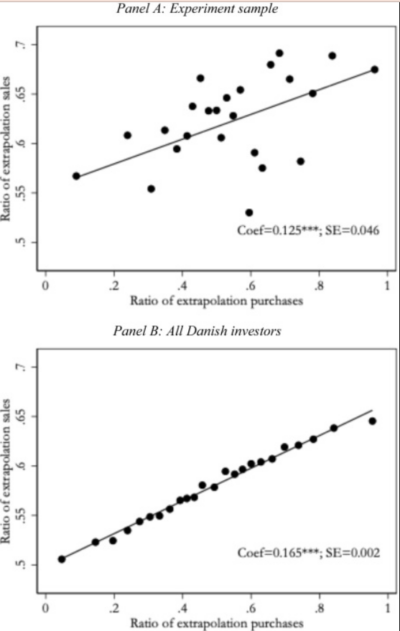
Note: The results depicted are hypothetical and should not be considered as indicators of future performance.
Abstract Summary
This study evaluates the impact of forecast bias on individual investor trading behavior by merging experimental bias assessments with real trading data. The results show a direct correlation between forecast bias and stock selection performance, indicating a clear behavioral mechanism influencing trading choices.
For more insights on this topic, visit Extrapolators and Contrarians: Forecast Bias and Individual Investor Stock Trading, originally published by Alpha Architect.