
Accounting | July 2, 2026
The 2026 Accountant Technology Survey: Turning Data Revelations into a Firm of the Future
New data from 725 accounting professionals reveals a profession in transition—and a clear blueprint for firms that want to lead it.




Concerns over AI rendering human accountants obsolete are rapidly fading. The narrative is evolving, as demonstrated by findings from the 2026 Intuit QuickBooks Accountant Technology Survey.
This survey, which encompasses input from 725 accounting and bookkeeping professionals across the U.S., illustrates an increasing appetite for accounting services and indicates that when effectively integrated, AI can transform both practices and client interactions. Despite this, many firms appear to be employing AI on an ad-hoc basis, limiting their competitive edge while more proactive firms continue to excel.
It's evident that holding onto outdated habits can trap firms in familiar dilemmas: juggling too many tools, excessive data cleaning, and a growing disparity between desired work and available capacity.
Significantly, the findings highlight a clear pathway for firms ready to confront these obstacles, positioning AI as a pivotal element alongside other industry elements.
Let’s dive into the insights from the survey and how they can be leveraged in your practice.
Are You a Firm of the Future? Your AI Usage Depends on It
AI adoption rates have shown little change since last year, with 88% of respondents confirming they use AI for at least one client service, while 86% deploy it within their firm’s operations. Common applications include data entry and processing (54%), financial forecasting (51%), and providing real-time insights (49%). Operational uses are just as varied, with invoicing and payments (53%), client communication (50%), and portfolio management (44%) leading the list.
Here’s where it gets fascinating; only 30% report that AI is embedded in their workflows as a standard practice. A significant 54% utilize AI situationally, incorporating it when needed instead of integrating it into their routine processes. The implications are stark: 77% of respondents believe the divide between firms that fully embrace AI and those that don't is growing.
The payoffs are significant for those who have embraced full integration. Among AI practitioners, 75% acknowledge that the tools have generated more value than they anticipated. The primary benefits anticipated over the next year include more manageable workloads (56%), enhanced confidence in deliverables (56%), and improved consistency in output quality (54%).
What this means for your firm: Shift your mindset—regard AI as an essential component rather than a trendy accessory. It’s crucial to integrate AI into your fundamental workflows. Identify two or three repetitive tasks where AI can serve as a first step in processing, and structure your review procedures around that. While occasional use has its advantages, systematic integration can redefine your firm’s capabilities. Firms that standardize AI use are not just observing faster workflows; they’re expanding their capacity to take on new projects.
Your Tech Stack May Be Hindering Your Capabilities—Probably Costing You Half a Day Every Week
AI isn't the sole determinant of your practice's efficiency; your technology stack plays a critical role too.
Technology is undeniably essential, but its cost is significant.
Data indicates that the typical accounting firm operates with roughly 10 different applications and software tools, with around one-third of firms engaging with 11 or more. Even with 92% of respondents investing in technology in the past year—a surge to an average spend of $21,000 from $19,000 in 2025—only 41% indicate that their tools are fully integrated. Nearly half (48%) describe their setup as functional yet fragmented.
The real cost of fragmentation? Accountants report an average of five hours lost each week due to the need to transfer, re-enter, or reconcile data across disconnected systems. That’s more than half a workday before any billable work even starts!
“This year’s data underscores how digital chaos contributes to the AI depth gap,” highlighted Jamerlyn Brown, principal communications manager at Intuit. “Firms are navigating numerous tools and expanding sets of AI capabilities with no clear guide on how to integrate them into their workflows. Those who maximize their technology will do so by being deliberate about where AI fits and where it does not.”
Firms should ensure their technology partners are attuned to their workflow needs and can adapt accordingly. For insights into how Intuit is enhancing its platform based on accountant feedback, check out this article: Intuit Connect ON: What You Need to Know About the Latest Platform Innovations.
What this means for your firm: Before acquiring new software, take stock of your current tools. Are they genuinely integrated, or are you paying for systems that require manual intervention? Firms consolidating their technology around a unified platform are reclaiming valuable hours each week that can be redirected to client services.
If you can’t easily track data movement across systems without human involvement, addressing that gap should be your top priority. Firms that continue to invest in new applications without tackling integration are not enhancing efficiency but rather complicating their operations.
Advisory Meets AI—Solutions to Overcome Bandwidth Concerns
Many accountants are eager to provide more advisory services, as these present opportunities to demonstrate value and foster firm growth. However, bandwidth issues stand in the way.
When asked which factors hinder their ability to undertake proactive advisory work, 30% cite manual data cleanup as the primary obstacle, helping ahead of staffing shortages (24%) and application overload (16%).
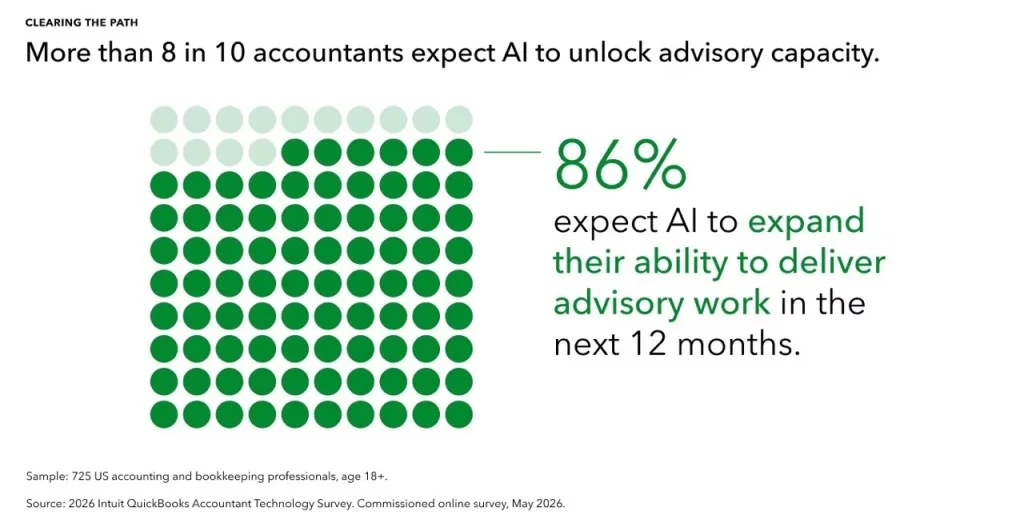
Yet, there’s a positive trend: 86% anticipate that AI will enhance their advisory capacity in the coming year, with 38% viewing it as a true unlock rather than just incremental assistance.
“Firms wishing to expand their advisory services are often hindered by operational capacity,” stated Brown. “Manual data cleanup is still a bottleneck, and AI can streamline that work, enabling accountants to focus more on providing guidance and engaging with clients.”
Outsourcing is also gaining traction as a complementary strategy alongside AI. For consecutive years, 80% of respondents reported outsourcing at least one service, primarily focusing on accounts payable (AP) and accounts receivable (AR) processing (43%), tax preparation (40%), and financial statement preparation (39%). Moreover, 65% aim to increase their outsourcing initiatives, an uptick from 63% in 2025.
What this means for your firm: Enhancing your advisory services necessitates addressing operational challenges. Identify the tasks consuming significant staff time without requiring human judgment, then make informed decisions on whether AI or outsourcing can take over those functions.
Firms that are advancing in advisory services aren’t necessarily those with the most skilled staff; they’re the ones actively working to eliminate friction from their processes. If manual data cleanup is your primary blocker, addressing it first is crucial.
Trust and Transparency—What Clients Feel and Expect
It might seem intuitive that AI could diminish your value or credibility in the eyes of clients. However, the opposite is true.
One major shift in this year's data is concerning client perceptions of AI. Approximately three out of five respondents report that clients frequently or always seek evidence of AI data protection. Strikingly, only 33% of accountants proactively explain how AI supports their work, and nearly half (49%) only address it when the client brings it up.
This passive approach could become a disadvantage; a significant 84% agree that strong AI data security practices are vital for both retaining existing clients and attracting new ones. Furthermore, 79% believe that, when used responsibly, AI strengthens client trust through improved consistency, earlier detection of problems, and better documentation.
Regarding the enduring value clients place on human expertise as AI takes on more routine tasks, 41% attribute it to trust and liability, with complexity management (31%) and empathy (22%) following closely.
“Eighty-five percent of accountants we surveyed believe that firms that thrive in the next decade will effectively combine AI efficiency with human competence and trust,” remarked Brown. “This combination requires transparency, not merely adoption.”
What this means for your firm: Your firm should articulate how you deploy AI in your operations before prompts arise from clients. Maintain clarity on this topic!
To foster transparency, create a concise and easily digestible summary of your AI utilization: the tools employed, their functions, human oversight, and client data protection measures. Firms that can communicate this effectively are transforming a potential concern into a distinct competitive edge, while those who remain silent risk giving competitors an advantage who are already capitalizing on this facet.
Combating Hiring Pressure—The Definition of a Good Hire is Changing
Hiring trends in 2026 show modest improvement, with 77% of respondents facing hiring challenges over the past year, down from 80% in 2025 and 94% in 2024. Nonetheless, significant obstacles remain across various experience levels. The toughest roles to fill involve candidates with one to five years of experience, with 46% and 42% of firms respectively struggling to fill those positions. Even entry-level roles present difficulties, with one-third citing challenges in finding quality candidates.
When firms do manage to hire, the return is delayed; 56% indicate that a new entry-level hire requires over six months to reach peak billable performance.
The expectations of what constitutes an ideal hire are evolving. When asked to prioritize expertise, 38% highlighted strategic judgment—interpreting complex data, assessing risks, and making recommendations—while AI fluency ranked second at 22%. For entry-level candidates, software and technology certifications (53%) and AI-related skills (53%) now rank equally ahead of CPA credential status (50%) as attributes that most enhance hiring prospects.
What this means for your firm: You need to rethink your hiring criteria. A candidate proficient in utilizing modern tools and comfortable working within AI-enhanced processes may deliver billable value more rapidly than a technically adept individual requiring re-training.
Expand your talent search to include candidates from adjacent fields like data analytics and IT. These candidates can offer the fluency your firm needs. Additionally, focus on reducing the ramp-up time for new hires through well-documented workflows, explicit onboarding frameworks, and AI-assisted quality checks that accelerate a new employee’s integration into a meaningful contributor.
Your Role is Expanding—And So Are Client Expectations
With the recent advancements in AI, it might be surprising that accountants are needed now more than ever.
Over half of respondents report heightened client demand across all financial categories, with financial management topping the list at 61%, followed closely by regulations and compliance (59%) and tax preparation (56%). Additionally, non-financial requests have become routine, as 62% of accountants indicate that clients seek more assistance on technology management, and 59% require guidance on business planning and strategies.
Moreover, a significant 77% now play a major or moderate role in supporting clients with HR and workforce management, and 70% say recent reduced IRS staffing has added to their administrative workload.
“The data suggests the conventional boundaries of an accountant's role are dissolving for many,” stated Brown. “Clients are no longer categorizing financial advice separately from business advice. They are merging technology inquiries, workforce issues, and strategic decisions into discussions with the same trusted advisor they consult for taxation. This trend signifies a significant shift in client perception of value in their relationships, consistently surfacing in recent years.”
What this means for your firm: The expanding scope of services is here to stay and has tangible implications for your pricing and service strategies. If you’re absorbing larger responsibilities without adjusting your fees or structural offerings, you risk undervaluing your practice.
Consider consolidating the advisory and consulting tasks you perform into clearly defined service offerings with appropriate pricing. The data shows that clients are relying on their accountants more than ever; the pivotal question now is whether you're capturing the full value of those relationships.
Ready to be a Firm of the Future? Make the Right Decisions to Get There
The firms that are successfully differentiating themselves have made a series of intentional decisions to break away from the competition.